
Top Contract Furniture Trends Shaping Commercial Interiors in 2026.
The contract furniture industry is entering a new phase, one that feels noticeably softer, more human, and far more experience-driven than the commercial interiors of the past decade.
Across workplace, hospitality, healthcare, and education sectors, designers are moving away from rigid corporate aesthetics and toward spaces that prioritise flexibility, emotional comfort, sustainability, and sensory experience. Furniture is no longer just functional infrastructure; it has become a key part of brand storytelling, wellbeing strategy, and spatial identity.
Here are the defining contract furniture trends shaping 2026.
Hospitality led design continues to influence the workplace.
The influence of hospitality interiors on commercial design is stronger than ever. Offices increasingly resemble boutique hotels, members’ clubs, and upscale lounges rather than traditional corporate environments.
Designers are specifying:
Residential style lounge seating
Soft modular seating
Upholstered meeting settings
Café inspired collaboration zones
Layered textures and ambient lighting
The objective is clear: create destinations people actively want to spend time in. Employers are investing in spaces that feel more welcoming, social and experience led rather than purely operational. The result is a softer environment that priorities well-being without sacrificing performance.
Warm minimalism replaces corporate grey
The cool monochromatic palettes that dominated commercial interiors throughout the 2010s are steadily fading. In their place we can see designers embracing the clear merge of hospitality design seeping into corporate spaces, designers are using warmer, more tactile colours inspired by hospitality design.
Trending finishes include:
Walnut and smoked oak
Espresso and chocolate browns
Terracotta and clay
Olive and moss greens
Sand, camel and muted neutrals
Burgundy accents
These palettes create environments that feel grounded, calming and emotionally comfortable which are particularly important in high-use, public workplace settings.
Curved silhouettes and organic forms dominate
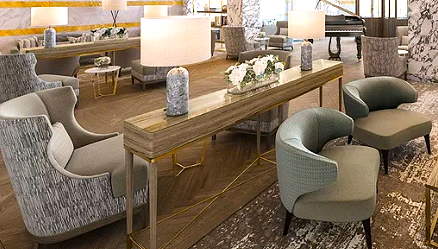
Curved seating in hotel lobby supplied by HRH Contract Furniture.
Commercial furniture is becoming noticeably softer in form. Rounded edges, sculptural seating, and organic geometrics are replacing the architectural minimalism seen in previous years. Designers are using curvature to create more inviting environments while subtly improving spatial flow and social interaction.
Expect to see:
Curved modular sofas
Circular collaborative settings
Soft-edge tables
Sculptural occasional seating
Organic shaped reception furniture
This shift aligns closely with human centered design principles, where interiors are intended to feel intuitive, calming and less visually rigid.
Texture takes centre stage
One of the strongest aesthetic shifts for 2026 is the return of tactile richness. Designers are layering materials and finishes to create spaces that feel sensory, warm, and visually engaging- particularly in hospitality and co-working spaces.
Popular applications include:
Bouclé upholstery
Ribbed timber detailing
Fluted joinery
Textural woven fabrics
Brushed metals
Matte stone finishes
Texture is also increasingly being used to support acoustics and comfort in open-plan environments.
Wellness driven furniture specification expands
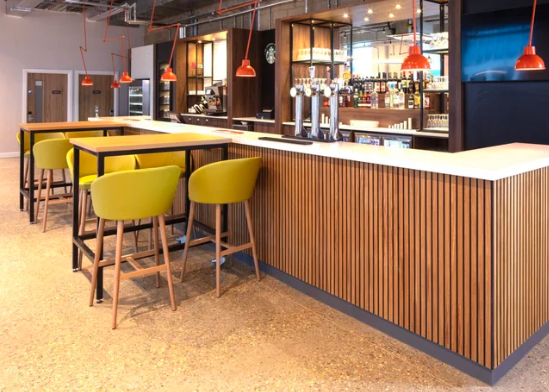
Bar seating in hotel lobby
Wellness continues to shape both workplace and public interior design strategies. Furniture is now expected to actively support physical and emotional wellbeing through ergonomics, acoustics, air quality, and sensory comfort.
Growing priorities include:
Ergonomic task seating
Sit-stand solutions
Acoustic privacy pods
Low-toxicity materials
Anti-microbial finishes
Quiet retreat spaces
This trend is especially prominent in workplace, education, and healthcare projects, where wellbeing standards are becoming more integrated into procurement frameworks.
Bespoke and craft-led design gains value
As brands seek greater differentiation, highly customised furniture solutions are becoming increasingly desirable.
Designers and clients are prioritising:
Custom upholstery
Locally influenced finishes
Statement feature pieces
Handcrafted detailing
Bespoke joinery integration
Commercial interiors are expected to communicate identity and narrative, not just simply provide function. Furniture therefore plays a growing role in expressing brand personality and creating memorable spatial experiences.
Looking ahead; the contract furniture landscape in 2026 is defined by a clear shift toward environments that feel more adaptable, sensory and human centred.
For designers, the focus is no longer solely on efficiency or aesthetics in isolation. The most successful commercial interiors are balancing:
Flexibility
Wellness
Emotional comfort
Brand experience
Ultimately, the future of contract furniture is less about creating spaces that simply just provide a function, and more about creating spaces people genuinely want to inhabit.
